Working in Heat: PCBU Duty Guide
By the eCompliance Central content team, guided by Dr Denise Meyerson, PhD · Oct 2026 · 12 min read
Working in heat is a health and safety risk that every PCBU must manage under the WHS Act 2011, and summer is the worst time to discover that no one owns the plan. With the hotter months only weeks away, organisations that move now can replace last-minute reactions with documented, reasonably practicable controls.
Why Heat Is a Compliance Issue, Not a Weather Issue
Summer Arrives Whether the Plan Is Ready or Not
Australian workplaces know that summer is coming, yet many still treat heat as an unpredictable event. Consequently, the first hot week becomes a scramble for water, fans and good intentions.
Regulators see it differently. Heat is a foreseeable hazard, and foreseeable hazards require planning before the exposure begins, not after a worker collapses.
The Hazard Is Not Limited to Outdoor Trades
Construction, agriculture and road work come to mind first. However, commercial kitchens, laundries, warehouses, vehicles and poorly ventilated factories all carry significant heat exposure.
Safe Work Australia is clear that indoor heat risks must be managed too. A PCBU with no outdoor workers can still have a heat problem.
A Foreseeable Hazard With Predictable Failure Points
Heat incidents tend to follow the same pattern. A hot day arrives, work continues as normal, and no one adjusts the roster, the task or the supervision.
This pattern matters because it shows that the failure is rarely a lack of knowledge. Instead, it is a lack of a trigger, an owner and a decision.
Executive Summary
- What this blog covers: Why working in heat is a PCBU duty, what the law expects, and how to build a heat plan that stands up to scrutiny.
- Who it's for: PCBUs, WHS managers, operations leaders, HR teams and officers who oversee outdoor, industrial or hot indoor work.
- Key regulatory context: WHS Act 2011, Model WHS Regulations, Safe Work Australia guidance and state regulators such as SafeWork NSW and WorkSafe Victoria.
- The central risk: Heat illness is progressive and can be fatal, yet most incidents trace back to missing triggers and unclear authority to stop work.
- Primary action required: Document a heat risk assessment, set escalation triggers, and train supervisors to act on them before the first heatwave.
What Working in Heat Actually Involves
There Is No Single Magic Temperature
Many managers ask what temperature requires work to stop. Safe Work Australia advises that no single figure applies, because risk depends on humidity, airflow, workload, duration and worker fitness.
A mild, humid day with heavy physical work can therefore be more dangerous than a dry, hot day with light tasks. Accordingly, a fixed temperature rule is a starting point, never the whole control.
Heat-Related Illness Is Progressive
Heat illness ranges from cramps and dehydration to heat exhaustion and heat stroke. Without intervention, it escalates, and heat stroke is a medical emergency.
Early warning signs give supervisors a window to act. Typical signs include:
- Dizziness, headache or visual disturbances
- Heavy sweating, or sweating that suddenly stops
- Nausea, cramps or unusual fatigue
- Confusion, irritability or slurred speech
- Fainting or collapse, which requires an immediate call to 000
Who Is Most at Risk
Workers who are new to heat, returning after a week or more away, or not yet acclimatised carry higher risk. Safe Work Australia also identifies younger workers, older workers, pregnant workers and people with certain medical conditions as more vulnerable.
Notably, acclimatisation varies between individuals, so it should never be the sole control. Organisations that design acclimatisation programs should seek input from a qualified professional such as an occupational hygienist.
Why Heat Management Fails in Practice
The Plan Exists but No One Owns the Trigger
Some organisations do have a heat policy. Even so, the policy often says 'monitor conditions' without naming who monitors, which source they use or what happens at each level.
Without a trigger, supervisors default to production targets. As a result, the policy sits unused while the shift continues.
- No named person responsible for checking forecasts and conditions
- No agreed escalation points tied to specific controls
- No authority for supervisors or workers to pause tasks
- No record that the plan was reviewed after the last hot season
Production Pressure Overrides Safety Judgement
Deadlines, contract penalties and customer expectations push crews to keep working. Meanwhile, workers hesitate to speak up because they fear being seen as weak or unproductive.
Leaders therefore need to make stopping or rescheduling a legitimate, praised decision. Otherwise the written controls will lose to the schedule every time. Our post on end-of-year compliance fatigue explains why tired teams make this trade-off more often.
Gaps Created by Labour Hire, Contractors and New Starters
Heat risk concentrates among people who know the site least. Labour hire workers, seasonal staff and new starters often receive thin inductions and little supervision.
Shared workplaces add another layer. Several PCBUs can hold duties for the same risk, so host and labour hire organisations should agree who controls shade, water, rest breaks and rescheduling.
Why Lone and Remote Work Raises the Stakes
Isolation delays recognition and rescue. A worker who collapses in a vehicle, a paddock or a plant room may not be found for some time.
Check-in procedures, buddy systems and reliable communications are therefore core controls, not extras, and they belong in the workplace emergency plan.

The Legal and Regulatory Context
PCBU Duties Under the WHS Act 2011
Under the WHS Act 2011, a PCBU must ensure, so far as is reasonably practicable, the health and safety of workers and others affected by the work. That duty covers a safe work environment, safe systems of work, adequate facilities, and information, training, instruction and supervision.
Heat does not need its own section to fall within these duties. If heat can cause illness, the duty to eliminate or minimise the risk applies.
What Regulators Expect to See
Regulators such as SafeWork NSW, WorkSafe Victoria, WorkSafe Queensland and Comcare publish heat guidance and urge PCBUs to plan before summer. When something goes wrong, inspectors typically look for evidence rather than intentions. Common requests include:
- A documented heat risk assessment for each type of work and location
- Consultation records with workers and health and safety representatives
- Training and induction records covering symptoms and emergency response
- Evidence that controls were applied on hot days, not just written down
- Incident and near-miss data used to review the plan
Notably, the Model WHS Regulations also contain requirements about workplace facilities and ventilation, so PCBUs should check how their state or territory applies them.
The Hierarchy of Controls Applies
The standard hierarchy of controls guides every heat plan. Elimination comes first, which can mean cancelling or rescheduling work until conditions ease.
Next come engineering controls such as shade, air-conditioning, insulation and ventilation. Administrative controls and personal protective equipment then address the residual risk, and the organisation must review all of them regularly.
Officer Due Diligence
Officers must also take reasonable steps to understand the hazards and gain assurance that resources and processes are in place. A heat plan that never reaches the board or executive agenda is therefore an officer risk as well as an operational one.
Leadership and Behavioural Compliance
Supervisors Decide Whether the Plan Is Real
A heat plan succeeds or fails at the point of supervision. Supervisors set the pace, approve breaks and notice when a worker looks unwell.
Training should therefore focus on decisions rather than definitions. For example, supervisors can practise what to do when the forecast turns, when a worker declines water, or when a client demands a push to finish.
- Check forecasts and site conditions before the shift starts
- Brief the crew on symptoms, water and rest expectations
- Rotate heavy tasks and allow self-pacing where possible
- Stop or reschedule work when controls no longer hold
Make Speaking Up Safe
Workers will report early symptoms only when they trust the response. Leaders can build that trust by thanking people who raise concerns and by acting on them visibly.
Health and safety representatives also have powers where there is a serious risk, so consultation with them should happen before summer rather than during a dispute.
The Gap Between a Heat Policy and Heat Control
Paper Controls Versus Working Controls
A policy describes intent, whereas a control changes what happens on the day. The gap between the two is where most heat incidents sit.
To test the gap, ask whether a new supervisor could find the triggers, name the responsible person and explain what happens at each level without help.
Questions That Expose the Gap
Before summer, leaders can ask a short set of questions and expect specific answers:
- Who checks conditions each day, and where is that recorded?
- What happens when the forecast reaches each trigger level?
- Who can stop work, and have they been told they can?
- How do contractors and labour hire workers receive the same protection?
The eCompliance Central Heat Risk Framework
Moving from policy to control requires a repeatable sequence. This framework gives PCBUs six steps that convert a general duty into daily decisions and records.
A 6-Step Framework for Control
Map Heat Exposure
Identify every task, location and vehicle where heat could harm workers, including indoor areas such as kitchens and plant rooms.
Assess Worker Factors
Consider workload, clothing, acclimatisation, age, health conditions and experience when rating the risk.
Set Clear Triggers
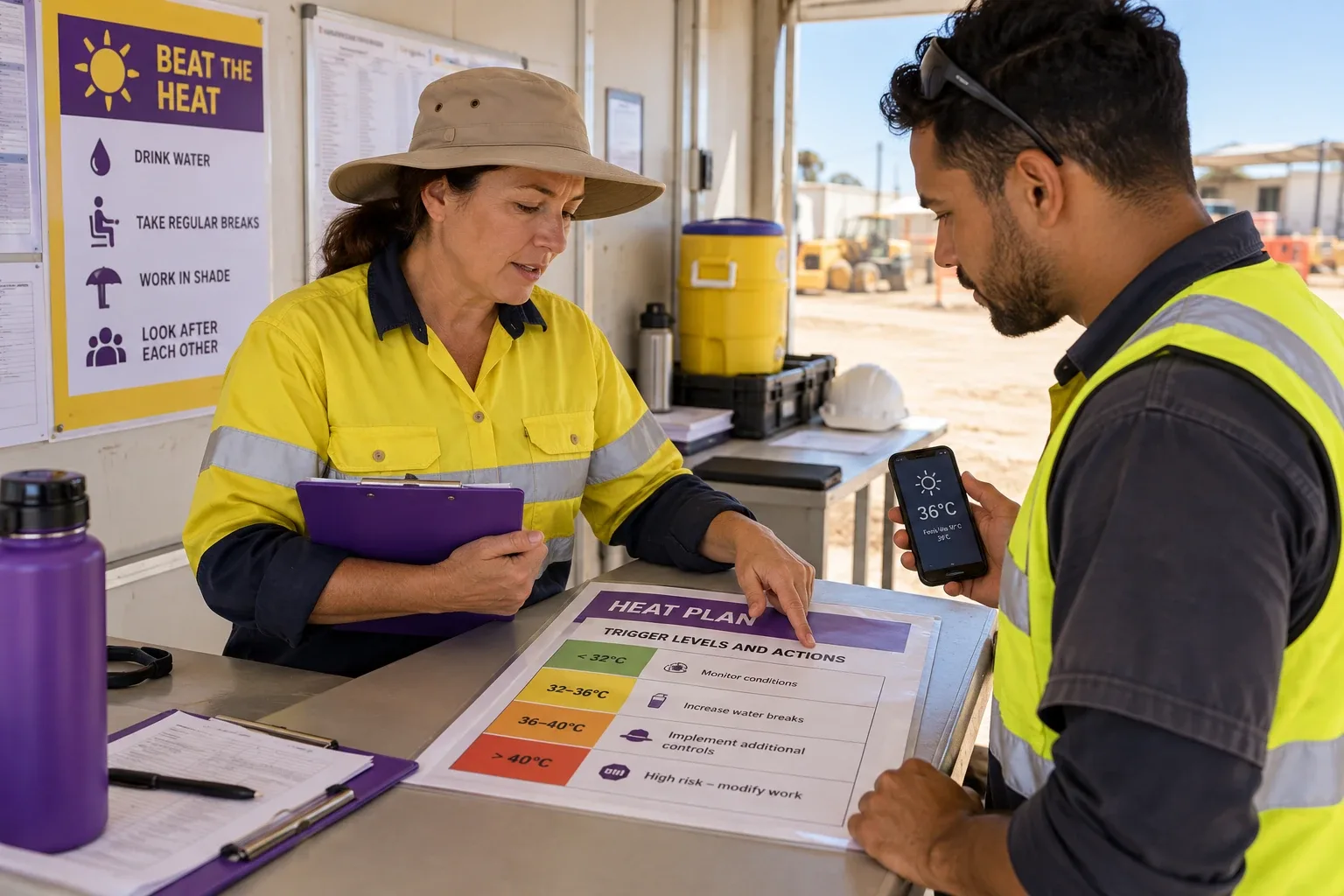
Link forecast and site conditions to defined controls so decisions do not depend on individual judgement.
Apply Layered Controls
Start with rescheduling and engineering measures, then add administrative controls and PPE for residual risk.
Prepare Emergency Response
Rehearse recognition, cooling and 000 procedures, and make sure remote workers can call for help.
Review and Evidence
Check whether controls worked after each hot spell and keep records that show the review happened.
Turning Triggers Into Habits
A framework only reduces risk when it runs automatically. Consequently, organisations should schedule a pre-summer review, assign named owners, and test the triggers in a short tabletop exercise before the first heatwave.
Consequences of Getting Heat Wrong
Legal and Financial Exposure
Heat-related deaths have led to prosecutions under WHS legislation. In one New South Wales matter, Linnane v Peak Gold Mines [2021] NSWDC 565, a mine was penalised after a worker died from heat stress underground, even though training and protocols existed. The failure was applying them on a known high-heat day.
That outcome illustrates a wider point. Having a system is not enough if the organisation does not use it when conditions demand it.
How a single missed trigger escalates:
- A hot day arrives and work continues without adjustment.
- A worker shows early symptoms that no one recognises or acts on.
- The worker collapses, a notifiable incident follows, and the regulator asks for the heat plan and records.
Operational and Cultural Costs
Beyond penalties, heat incidents bring lost time, workers' compensation claims, project delays and damaged trust. Furthermore, crews remember how leaders responded and adjust their willingness to speak up accordingly.
Strong heat management therefore protects productivity as well as people. Rested, hydrated workers make fewer errors, and that benefit appears on every roster.
Compliance Intelligence: Key Insights
- ✓ No single temperature determines heat risk, so rigid thresholds without context create false confidence.
- ✓ Indoor workplaces such as kitchens, laundries and warehouses carry heat obligations equal to outdoor sites.
- ✓ A heat policy without named owners and triggers is a statement of intent, not a control.
- ✓ Acclimatisation varies between individuals and should never be the only protection.
- ✓ Labour hire and contractor workers often face the highest heat risk with the thinnest induction.
- ✓ Regulators ask for evidence that controls ran on the hot day, not just that a policy existed.
- ✓ Making it legitimate to stop work is the cheapest and most effective heat control available.
Key Takeaways
- Complete a documented heat risk assessment for every task and location before summer begins.
- Assign a named person to check conditions daily and record the result.
- Define trigger levels that link forecasts to specific controls.
- Authorise supervisors and workers to pause or reschedule tasks when controls fail.
- Consult workers and health and safety representatives on the plan before the season starts.
- Train supervisors to recognise symptoms and respond, including calling 000 for suspected heat stroke.
- Agree heat responsibilities in writing with labour hire providers and contractors.
- Review controls after each heatwave and keep the evidence.
Frequently Asked Questions
Is there a maximum temperature at which work must stop in Australia?
Safe Work Australia advises that no single temperature applies across all work. Instead, PCBUs must assess heat, humidity, airflow, workload and worker factors, then eliminate or minimise the risk so far as is reasonably practicable. Some workplaces adopt internal triggers, which are useful when they link directly to controls. State and territory regulators may also provide specific guidance, so check your local requirements.
What are a PCBU's duties for working in heat under the WHS Act 2011?
A PCBU must ensure, so far as is reasonably practicable, a work environment and systems of work that are without risks to health. In practice, that means identifying heat hazards, assessing the risk, applying controls in the hierarchy order and reviewing them. It also means providing information, training and supervision. Officers must take reasonable steps to confirm these processes exist.
Do indoor workplaces need a heat plan?
Yes. Commercial kitchens, laundries, factories, warehouses and vehicles can all expose workers to dangerous heat. Safe Work Australia notes that indoor heat risks must be managed, and ventilation and cooling are common controls. Sedentary work may tolerate warmer conditions, so the assessment should reflect the task.
What is the difference between a heatwave and a hot day?
Safe Work Australia describes a heatwave as unusually hot maximum and minimum temperatures over at least three days. Overnight temperatures matter because workers have less chance to recover. Heatwaves therefore call for additional risk assessment and tighter controls such as earlier start times and reduced physical effort.
How should supervisors respond to suspected heat stroke?
Heat stroke is a medical emergency, so supervisors should call 000 immediately. While waiting, they should move the worker to a cool place with circulating air, loosen or remove heavy clothing, and begin cooling. Regulators such as Comcare publish first-response guidance that organisations can include in training.
Can a health and safety representative stop work because of heat?
Under the model WHS laws, a health and safety representative who has completed the required training may direct a worker to cease unsafe work where there is a serious risk. Generally, they must first try to resolve the matter with the PCBU unless urgency makes that unreasonable. PCBUs should therefore consult representatives on heat plans early.
How does heat management apply to contractors and labour hire workers?
Several PCBUs can hold duties for the same risk, so each must consult, cooperate and coordinate. The host and the labour hire provider should agree in writing who supplies water, shade and rest areas and who can reschedule work. Inductions should also cover heat symptoms and reporting.
eCompliance Central are professional educators, not legal advisers. This article is general information only. For advice on your specific situation, please consult a qualified legal professional.
Build a Heat Plan Your Teams Will Actually Use
eCompliance Central designs customised, SCORM-ready WHS training built around your sites, roles and risks, so supervisors know exactly what to do when the forecast turns.
Explore Custom Compliance Solutions eCompliance Central content team, guided by Dr Denise Meyerson, PhD.