Phishing Awareness Training Guide
By the eCompliance Central content team, guided by Dr Denise Meyerson, PhD · Oct 2026 · 11 min read

Phishing awareness training only protects an organisation when it changes what people do under pressure. Australians reported more than $2 billion in scam losses in 2025, according to ACCC figures, and phishing was the most commonly reported scam type. For PCBUs that hold personal information, the question is no longer whether staff will receive a convincing message, but whether the organisation can show it took reasonable steps beforehand.
Why Phishing Is a Compliance Issue, Not Just an IT Issue
The Scale of the Problem
Reported scam losses passed $2 billion in 2025, and online scams involving financial loss rose by about 31.8%. Payment redirection scams, where criminals impersonate a supplier and change bank details, cost Australians more than $166 million.
Meanwhile, attackers increasingly use generative tools to write fluent, personalised messages. As a result, the old advice to look for spelling mistakes no longer works.
From Technical Risk to Legal Exposure
A successful phishing email often ends in a data breach, a fraudulent payment or a locked network. Each outcome triggers obligations under privacy law, contracts and, for some organisations, sector rules.
Therefore, boards and officers now treat phishing as an enterprise risk. IT controls matter, yet regulators also ask what the organisation did to prepare its people.
Why October Is the Right Moment
Cyber Security Action Month runs each October and puts scam awareness in front of the public. Organisations can use that attention to refresh their own program, measure results and report to leadership before year-end.
Moreover, new scam-prevention rules for banks, telecommunications providers and digital platforms took effect on 1 September 2026. They raise the standard of defence upstream, but they do not remove the duty on a PCBU to protect its own systems and data.
Executive Summary
- What this blog covers: Why phishing awareness training is a compliance matter, what Australian law expects, and a six-step framework that pairs training with controls.
- Who it's for: PCBUs, officers, compliance officers, privacy officers, HR and L&D leaders and IT managers across Australia.
- Key regulatory context: Privacy Act 1988 (APP 11 and the Notifiable Data Breaches scheme), WHS Act 2011, and guidance from the Office of the Australian Information Commissioner and the Australian Cyber Security Centre.
- The central risk: Staff act on a convincing message before controls can stop them, and the organisation cannot show it took reasonable steps.
- Primary action required: Combine role-based training, simulations and technical controls such as multi-factor authentication, then record results and review them.
What Phishing Awareness Training Needs to Achieve
Defining the Threat
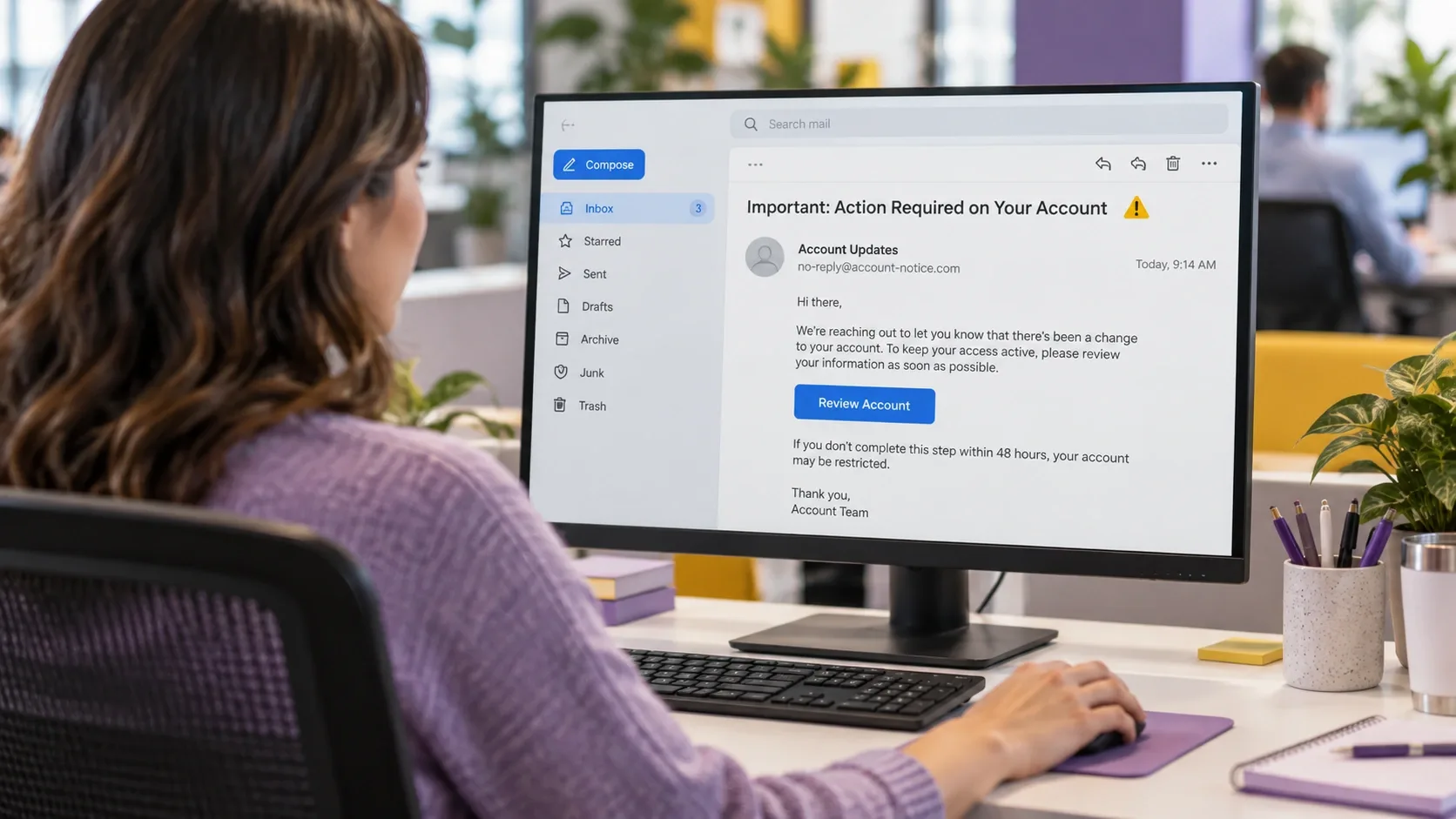
Phishing is a deception that persuades a person to reveal credentials, approve a payment or open malicious content. It arrives by email, SMS, voice call, messaging apps and even QR codes.
Importantly, the target is human judgement. A well-designed attack exploits urgency, authority and routine.
What Good Training Looks Like
Effective programs go well beyond an annual video. Look for the following features:
- Short, scenario-based lessons built around the organisation's real tools and suppliers.
- Role-based content for finance, HR, executives and frontline staff.
- Simulated phishing exercises followed by supportive feedback, not blame.
- Clear instructions on how to report a suspicious message in one step.
- Refreshers triggered by new scam types and by incidents.
Training Is One Control Among Many
Experts consistently warn that awareness cannot be the only defence against sophisticated attacks. Multi-factor authentication, payment verification and monitoring catch what people miss.
Consequently, training should be designed as one layer in a set of controls, with each layer assuming the others may fail.
Why Staff Still Click
Common Organisational Causes
Click rates reflect workplace conditions as much as individual attention. Several patterns recur:
- Time pressure, especially at month-end and during busy periods.
- Generic training that bears no resemblance to the messages staff actually receive.
- Reporting processes that feel slow, or that make the reporter look careless.
- Finance processes that allow bank-detail changes without independent verification.
The Blame Problem
When staff fear punishment, they hide mistakes. A worker who clicked a link but keeps quiet gives attackers hours of extra access.
In contrast, a no-blame reporting culture shortens detection time and limits damage.
Attacks That Bypass Awareness
Some attacks use stolen but valid credentials, so nothing looks wrong to the user. Others impersonate a known supplier so well that even trained staff comply.
Accordingly, controls such as payee verification and behavioural monitoring are essential companions to training.
What Australian Law Expects
Privacy Act 1988 and Reasonable Steps
Australian Privacy Principle 11 requires organisations covered by the Privacy Act to take reasonable steps to protect personal information from misuse, interference, loss and unauthorised access. Staff training is a commonly cited part of those steps.
In addition, the Notifiable Data Breaches scheme requires notification to the Office of the Australian Information Commissioner and affected individuals when an eligible breach is likely to cause serious harm.
WHS Act 2011 Connections
The WHS Act 2011 requires a PCBU to provide the information, training and instruction needed to protect workers from risks to health and safety. Scams also carry a human cost, because staff who are deceived or blamed can suffer significant stress.
Under section 27, officers must exercise due diligence to ensure the PCBU meets its duties, which includes understanding hazards and verifying that reporting systems work. Our guide to WHS officer due diligence explains those duties in more detail.
What Regulators Expect to See
The Office of the Australian Information Commissioner and the Australian Cyber Security Centre both emphasise evidence of preparation. Commonly requested records include:
- A documented cyber risk assessment that covers social engineering.
- Training content, completion data and results of simulations.
- Incident reporting procedures and examples of their use.
- Technical controls such as multi-factor authentication and payment verification.
- Board or officer reports showing oversight.
Some organisations also face ransomware payment reporting duties under the Cyber Security Act 2024, so check which obligations apply to you.
Leadership and Behavioural Compliance
What Leaders Must Model
Culture shapes how quickly staff report a mistake. Leaders can set the tone through visible habits:
- Report their own suspicious messages, and share the story.
- Thank staff who flag false alarms as well as real attacks.
- Follow payment verification rules even when the request appears to come from an executive.
- Include cyber risk in regular board and officer reporting.
Targeting the Highest-Risk Roles
Finance officers, executive assistants, HR staff and IT administrators attract the most sophisticated attacks. They need deeper, more frequent training than a general staff module provides.
Likewise, new starters are vulnerable during their first weeks, so include phishing basics in induction.
The Gap Between Completion and Resilience
Understanding the Resilience Gap
A completion rate shows that people watched a module. A resilience measure shows whether they behave differently when a real message arrives.
Most PCBUs can report the first figure, yet far fewer can report reporting rates, time to report or repeat-clicker trends.
Signs Your Organisation Has a Gap
A short check helps. If any of the following statements is true, a gap probably exists:
- Training has not changed since it was first purchased.
- Simulations have never been run, or results are not shared with leaders.
- Staff cannot say how to report a suspicious message.
- Bank-detail changes can be approved by one person without a call-back.
The eCompliance Central Phishing Resilience Framework
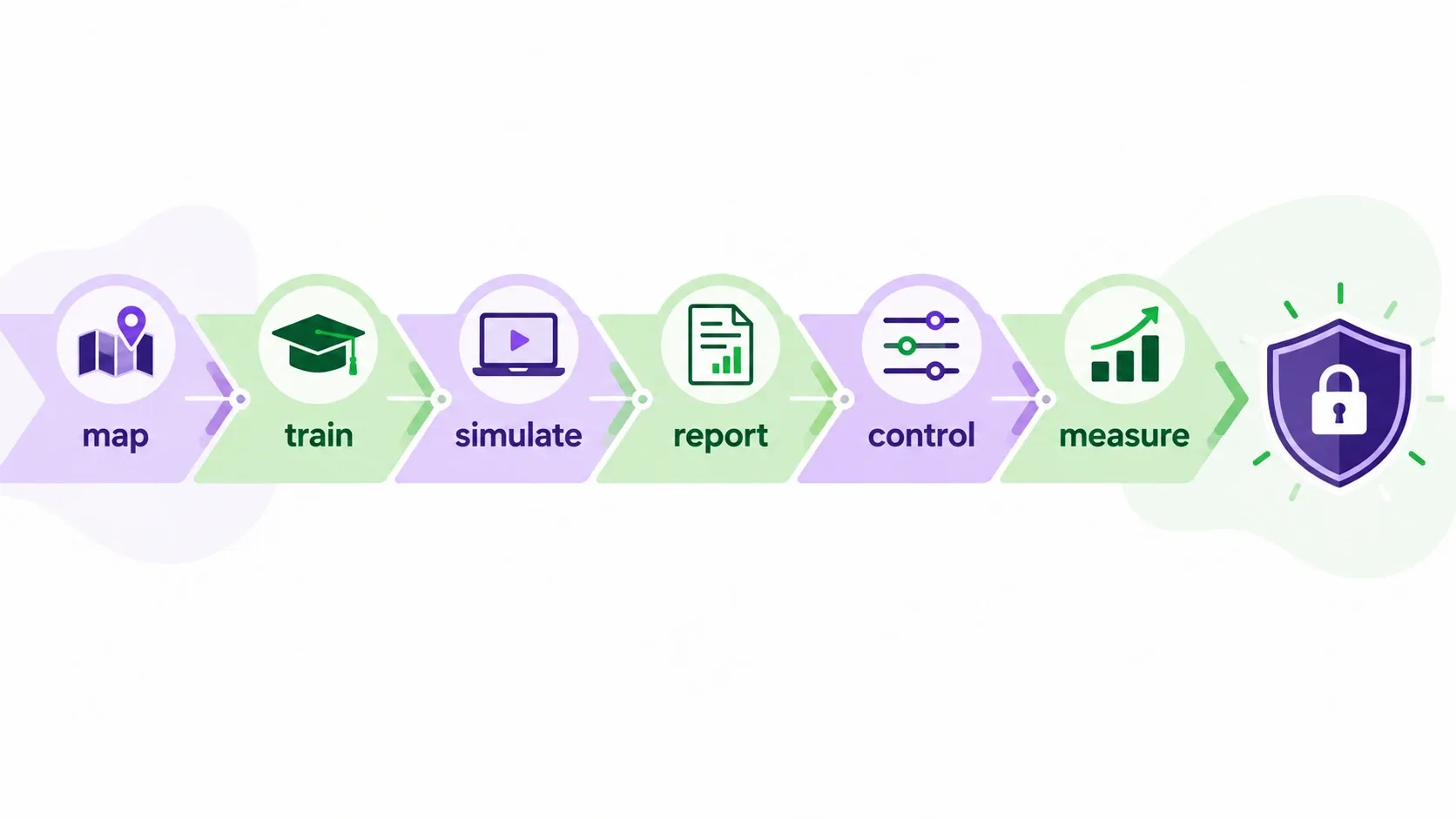
This framework turns awareness into measurable resilience. Each step creates a record that an auditor, regulator or board can inspect.
A 6-Step Framework for Control
Map Your Exposure
Identify the roles, systems and processes that attackers are most likely to target, such as payments and payroll.
Train by Role
Deliver short, realistic scenarios tailored to each group, and refresh them when new scams appear.
Simulate and Coach
Run phishing simulations regularly, then follow up with supportive feedback rather than discipline.
Make Reporting Easy
Give staff one clear action, such as a report button, and acknowledge every report quickly.
Layer Technical Controls
Back people up with multi-factor authentication, payee verification and monitoring for unusual access.
Measure and Report
Track reporting rates and response times, then brief officers each quarter and adjust the program.
Building Resilience Into Routine
A framework protects an organisation only when it runs on a schedule. Plan simulations across the year, tie refreshers to new threats and incidents, and keep dated records so the program can be demonstrated on request.
Consequences of Getting It Wrong
Regulatory and Financial Exposure
A phishing-led breach can bring notification duties, regulator inquiries, contractual claims and direct financial loss. Organisations that cannot show reasonable steps are in a weaker position.
A typical escalation looks like this:
- A staff member receives a convincing message and enters credentials or approves a payment.
- The attacker accesses systems or redirects funds before anyone notices.
- The organisation must notify, investigate and explain what preparation existed beforehand.
Operational and Human Cost
Beyond the immediate loss, incidents disrupt operations and damage trust with customers and suppliers. The staff member involved may also carry lasting stress.
For related privacy risks, see our article on AI privacy compliance, which covers data leaving the organisation through unapproved tools.
Compliance Intelligence: Key Insights
- ✓ Phishing was the most commonly reported scam type in Australia in 2025.
- ✓ Awareness training is one control layer and should never stand alone.
- ✓ A fluent, personalised phishing message is now cheap to produce at scale.
- ✓ No-blame reporting shortens the time between a click and containment.
- ✓ Payee verification stops many payment redirection scams that fool trained staff.
- ✓ Completion rates measure attendance, while reporting rates measure behaviour.
- ✓ Officers who see no phishing metrics cannot show due diligence.
Key Takeaways
- Map the roles and processes most exposed to phishing and payment fraud.
- Replace generic training with role-based, scenario-led lessons.
- Run simulations on a schedule and coach rather than punish.
- Give staff a one-step way to report suspicious messages.
- Require independent call-back verification for bank-detail changes.
- Make multi-factor authentication a baseline control across systems.
- Track reporting rates and time to report, not completion alone.
- Brief officers every quarter on phishing results and incidents.
Frequently Asked Questions
What is phishing awareness training?
It is training that teaches staff to recognise, resist and report deceptive messages designed to steal credentials, money or data. Good programs use realistic scenarios, simulations and clear reporting steps. They also link to technical controls rather than relying on awareness alone.
Is phishing awareness training legally required in Australia?
No single law prescribes a training program. However, APP 11 under the Privacy Act 1988 requires reasonable steps to protect personal information, and training is a common part of those steps. The WHS Act 2011 also requires PCBUs to provide information, training and instruction about workplace risks.
How often should staff complete phishing training?
Most organisations combine an annual core module with shorter refreshers and regular simulations. High-risk roles often need more frequent sessions. In addition, new scam types and incidents should trigger targeted updates.
Do phishing simulations breach staff trust?
They can if handled poorly. Explain the purpose in advance, avoid humiliating results and focus on coaching. Moreover, share aggregate results with leaders rather than naming individuals.
What should a PCBU do after a staff member clicks a phishing link?
Report it immediately, isolate the affected account, change credentials and begin an assessment of any data accessed. If personal information may be involved, assess whether the Notifiable Data Breaches scheme applies. Treat the staff member supportively so others report quickly.
Is training enough to stop phishing?
No. Even well-trained staff can be deceived by sophisticated attacks. Therefore, pair training with multi-factor authentication, payment verification and monitoring, so that one mistake does not become a major incident.
eCompliance Central are professional educators, not legal advisers. This article is general information only. For advice on your specific situation, please consult a qualified legal professional.
Turn Awareness Into Measurable Resilience
eCompliance Central builds customised, SCORM-ready training around your policies, people and operations, so your phishing defences are practised, measured and documented.
Explore Custom Compliance Solutions eCompliance Central content team, guided by Dr Denise Meyerson, PhD.