Workplace Exposure Limits: PCBU Guide
By the eCompliance Central content team, guided by Dr Denise Meyerson, PhD · Nov 2026 · 12 min read
Workplace exposure limits take over from workplace exposure standards across Australia on 1 December 2026, and every PCBU that uses chemicals, dusts or fumes needs to know what that means for its controls. Most values stay the same, but some drop, some rise and some substances are new. Organisations that wait until December to check their data will be reviewing risk assessments after the rules have already changed.
Why Workplace Exposure Limits Matter Now
A Rename With Real Consequences
Safe Work Australia has confirmed that WHS ministers agreed a new list of workplace exposure limits (WEL) with a harmonised transition period ending on 30 November 2026. The WEL list replaces the workplace exposure standards (WES). The new name signals that each value is a limit that must not be exceeded, and it aligns Australia with international terminology.
However, the change is more than cosmetic. Safe Work Australia's review adjusted values for a number of chemicals, removed some entries and added others. Therefore, an exposure assessment that was sound under the old list may no longer demonstrate compliance.
The Date PCBUs Need in Their Diaries
Until 1 December 2026, PCBUs must keep ensuring that no person is exposed to an airborne concentration above the WES list value. From 1 December 2026, and following implementation into the WHS laws of the Commonwealth, states and territories, the WEL list applies. Consequently, the exact start date in each jurisdiction depends on how that jurisdiction adopts the list.
Safe Work Australia also notes that further guidance will appear throughout the transition period and beyond. Organisations should treat the weeks before December as a preparation window, not a grace period.
Who Is Most Exposed to the Change
Manufacturing, construction, mining, laboratories, automotive repair, cleaning, agriculture and healthcare all use substances that generate airborne contaminants. Even so, the duty sits with every PCBU that exposes workers to dusts, fumes, vapours or mists, including those that never think of themselves as chemical businesses.
Smaller operators are often the least prepared. They rely on supplier safety data sheets, and they rarely hold monitoring results that could be compared with a revised limit.
Executive Summary
- What this blog covers: What the move from workplace exposure standards to workplace exposure limits means for PCBUs, and how to prepare before 1 December 2026.
- Who it's for: PCBUs, WHS managers, operations leaders, procurement teams and officers who oversee hazardous chemicals.
- Key regulatory context: The WHS Act 2011, the Model WHS Regulations (hazardous chemicals), and guidance from Safe Work Australia, SafeWork NSW, WorkSafe Victoria and other regulators.
- The central risk: Exposure data and risk assessments that were built on the old standards no longer prove that workers are protected.
- Primary action required: Review airborne contaminant risk assessments, SDS records and monitoring evidence against the new list, and record the outcome.
What Workplace Exposure Limits Are and What Changes
Defining a Workplace Exposure Limit
A workplace exposure limit is the maximum airborne concentration of a substance that a person may be exposed to over a stated period. Limits are usually expressed as an eight-hour time-weighted average, and some substances carry short-term or peak values as well. They are measured in the worker's breathing zone, not in the general room air.
What the Revised List Contains
Safe Work Australia reports that most limits are unchanged. In practice, though, the review produced several kinds of movement, and each one needs checking against the substances a workplace actually holds.
- Reductions for some chemicals, which may turn a previously acceptable exposure into a breach.
- Increases for some chemicals, which may allow organisations to review controls that were set conservatively.
- Limits that were removed and limits that were newly introduced.
- New short-term or peak values for substances that previously had only a time-weighted average.
- A different approach for non-threshold genotoxic carcinogens, which have no safe exposure level.
Items Still Being Decided
Safe Work Australia has flagged nine substances that need further impact analysis before their WEL values are updated: respirable crystalline silica, formaldehyde, benzene, chlorine, copper (fumes, dusts and mists), hydrogen cyanide, hydrogen sulphide, nitrogen dioxide and titanium dioxide. Additionally, 33 airborne contaminants that are non-threshold genotoxic carcinogens have no safe limit, and the regulator is still deciding how to treat them.
Until 1 December 2026, the existing WES values continue to apply to those substances. As a result, PCBUs that use any of them should watch for regulator updates rather than assume the transition is settled.
Why Exposure Control Fails in Practice
Paperwork That Ages Faster Than the Workplace
Risk assessments for airborne contaminants are often completed once and filed. Meanwhile, processes change, suppliers substitute products, and ventilation systems age. A limit change adds one more reason for the assessment to be out of date.
- Safety data sheets that are years old and not tied to the current chemical register.
- Monitoring results that describe a past process, not the present one.
- Local exhaust ventilation that is installed but rarely tested.
- Respiratory protection used as the first control instead of the last.
Reliance on Suppliers and Assumptions
Many PCBUs assume that a compliant product means a compliant workplace. Yet a supplier's data sheet describes the substance, not how a particular team uses it. Task duration, enclosure, temperature and housekeeping all change real exposure.
Similarly, workers on contract or labour hire arrangements are easy to overlook in exposure records. The PCBU's duty extends to every person at the workplace who could be affected.
Warning Signs Leaders Should Not Ignore
Some indicators suggest that exposure controls are weaker than the paperwork says. Leaders who act on these early avoid larger problems later.
- Workers report irritation, odours, coughs or headaches during particular tasks.
- Dust is visible on surfaces or in light beams at the end of a shift.
- Respirator fit testing has lapsed or never happened.
- Nobody can say when air monitoring was last completed.
None of these signs proves a breach. Nevertheless, each one is a reason to gather better data before the limits change.

The Legal Framework Behind Exposure Limits
PCBU Duties Under the WHS Act 2011
Under the WHS Act 2011, a PCBU must ensure, so far as is reasonably practicable, the health and safety of workers and others affected by its work. That duty covers airborne contaminants because exposure to them is a recognised source of illness. Jurisdictions that have not adopted the model laws apply equivalent duties under their own legislation.
The Model WHS Regulations add specific obligations for hazardous chemicals, including managing risk and monitoring airborne contaminant levels where there is uncertainty about exposure. Organisations should confirm the exact regulation numbers in their own jurisdiction.
How Regulators Approach Exposure
Safe Work Australia sets the model standard, and each state and territory regulator enforces its own version. SafeWork NSW has advised PCBUs to review their controls before 1 December 2026, and WorkSafe Victoria directs Victorian employers to its own guidance. Regulators in other jurisdictions are publishing similar material.
When inspectors examine airborne contaminant risk, they typically ask for evidence in several areas.
- The chemical register and current safety data sheets.
- Risk assessments that identify the substances and tasks involved.
- Evidence that higher-order controls were considered before respirators.
- Air monitoring results and the competence of the person who collected them.
- Worker training, consultation and health monitoring records.
A PCBU that holds this evidence in an organised form can respond quickly. By contrast, one that must reconstruct it during an inspection starts from a weak position.
Officer Due Diligence and Consultation
Officers must exercise due diligence to ensure the PCBU meets its duties, which includes understanding the hazards of the operation and verifying that resources and processes are in place. A change to exposure limits is a clear moment to ask for assurance. Our guide to WHS officer due diligence explains what that looks like in practice.
The PCBU must also consult workers and health and safety representatives on matters that affect their safety. Consultation about revised limits and any changes to controls therefore belongs in the plan.
Leadership and Behavioural Compliance
Making Exposure a Leadership Metric
Leaders signal what matters by what they ask about. If monthly reports include incidents but no exposure data, the organisation learns that airborne risk is a background issue.
- Add chemical exposure and monitoring status to board and executive WHS reports.
- Ask for a named owner for every substance of concern.
- Require a documented review whenever a process, product or supplier changes.
- Fund competent monitoring before an incident forces the spend.
Building Habits That Protect Workers
Controls only work when people use them as intended. Supervisors need to notice when an extraction hood is switched off, when lids are left open, or when a task is rushed. Likewise, workers need to feel safe reporting symptoms without being seen as difficult.
Training should explain why a limit exists, not only what the number is. Workers who understand the health effects of dusts and fumes are more likely to follow procedures when no one is watching.
From Exposure Standards to an Evidence Trail
The Gap Between Compliance and Proof
A workplace can be well controlled and still lack the evidence to show it. That gap matters because a regulator, an insurer or a court will rely on records, not recollection. The aim is to turn day-to-day control into a trail that shows each decision and the reason for it.
Safe Work Australia's guidance for PCBUs on air monitoring and exposure limits is a useful anchor for that trail. It replaces earlier interpretation guidance from 1 December 2026.
What a Defensible Record Includes
A defensible record links hazard, assessment, control and verification in one place. Specifically, it should cover the points below.
- The substance, its location in the process and the limit that applies.
- The controls in place, ranked from elimination down to personal protective equipment.
- Air monitoring results, who collected them and when.
- Training, consultation and health monitoring evidence.
- Review dates and the trigger that caused each review.
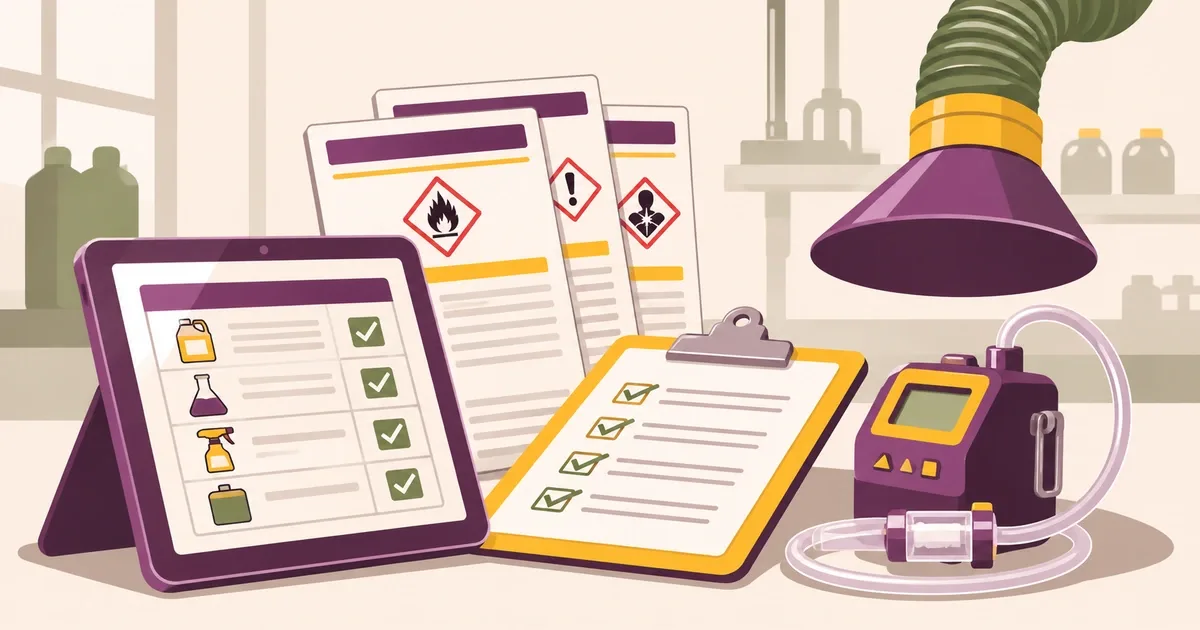
The eCompliance Central Exposure Limit Readiness Framework
Preparing for the new list does not require a complete rebuild of the WHS system. It requires a structured pass through the substances, the controls and the evidence. The following framework gives PCBUs a repeatable way to do that before and after 1 December 2026.
A 6-Step Framework for Control
Map Your Substances
Start with the chemical register and list every substance that can become airborne. Link each one to the tasks, locations and people involved.
Check Against the List
Compare current values with the WEL list and note every reduction, increase, removal or new limit. Flag the nine substances still under review.
Reassess the Risk
Review each task where exposure could approach a limit. Use competent advice where results are uncertain.
Test the Controls
Verify that ventilation, enclosure and housekeeping work as designed. Prioritise elimination and substitution before respirators.
Monitor and Verify
Commission air monitoring through a competent person, such as an occupational hygienist, where exposure is uncertain.
Record and Review
Capture decisions, evidence and consultation in one register. Set review triggers for process changes and regulator updates.
Turning the Framework Into a Routine
The framework works best as an annual cycle, not a one-off project. Assign an owner to each step, report progress to officers, and revisit the list whenever Safe Work Australia or the local regulator publishes an update.
What Is at Stake If Exposure Controls Lag
Health, Legal and Operational Consequences
Airborne contaminants cause harm that may appear years after exposure, including lung disease and cancer. Because of that delay, a workplace may not see the damage until long after the decision that caused it. Regulators can issue improvement or prohibition notices and can prosecute for breaches of WHS duties.
How a small gap becomes a serious one:
- An out-of-date assessment fails to flag a reduced limit.
- Workers are exposed above the new value without anyone noticing.
- A health complaint or inspection reveals the gap and triggers regulatory action.
Business and Reputation Impact
Beyond penalties, organisations face workers' compensation claims, lost production and damaged client trust. Procurement teams in larger organisations increasingly ask suppliers for evidence of chemical safety management.
Conversely, a PCBU that can show a clear, current exposure record often finds audits and tenders easier. That advantage is a practical reason to act early.
Compliance Intelligence: Key Insights
- ✓ From 1 December 2026, workplace exposure limits replace workplace exposure standards, subject to adoption in each jurisdiction.
- ✓ Most limits are unchanged, but a chemical register is the only way to know which of yours moved.
- ✓ Nine substances, including respirable crystalline silica, remain under further impact analysis.
- ✓ Thirty-three non-threshold genotoxic carcinogens have no safe limit, so elimination or the lowest practicable exposure is the goal.
- ✓ Respirators are the last line of defence, not the first control.
- ✓ Air monitoring should be done by a competent person when exposure is uncertain.
- ✓ An exposure record that cannot be produced in an hour is a weak defence.
- ✓ Officers who ask for exposure data show due diligence before an incident, not after.
Key Takeaways
- Build or update the chemical register so every airborne contaminant links to a task and a location.
- Compare each substance with the new WEL list before 1 December 2026.
- Reassess any task where exposure sits close to a revised limit.
- Prioritise elimination, substitution and engineering controls over respirators.
- Commission air monitoring from a competent person where results are uncertain.
- Check respirator fit testing, training and maintenance records.
- Consult workers and health and safety representatives about changes.
- Record decisions and set review triggers for regulator updates.
Frequently Asked Questions
When do workplace exposure limits start in Australia?
Safe Work Australia states that the WEL list applies from 1 December 2026, following implementation into the WHS laws of the Commonwealth, states and territories. Until then, the workplace exposure standards continue to apply. PCBUs should confirm the position with their local regulator.
What is the difference between workplace exposure standards and limits?
The values are largely the same, but the name changes to reflect that each figure is a limit that must not be exceeded. The revised list also changes some values, removes some entries and adds new ones. Organisations should therefore recheck each substance rather than assume nothing has moved.
Do small businesses need to follow the new limits?
Yes. The WHS Act 2011 places duties on every PCBU, regardless of size. A small workshop that generates dust or fumes must ensure workers are not exposed above the applicable limit, so far as is reasonably practicable.
When is air monitoring required?
Safe Work Australia advises that PCBUs must conduct air monitoring if they are uncertain whether a substance exceeds the limit, or if monitoring is needed to determine whether there is a risk to health. A competent person, such as an occupational hygienist, should carry it out.
What should PCBUs do about substances still under review?
Safe Work Australia has said nine substances need further impact analysis and that 33 non-threshold genotoxic carcinogens are still being considered. PCBUs should keep complying with the current standards and watch for updates. Meanwhile, they can apply the usual hierarchy of control to reduce exposure.
Do officers have a role in exposure limit compliance?
Officers must exercise due diligence under the WHS Act 2011. That includes understanding the operation's hazards and verifying that resources and processes exist to manage them. Asking for exposure data and a transition plan is a practical way to meet that expectation.
eCompliance Central are professional educators, not legal advisers. This article is general information only. For advice on your specific situation, please consult a qualified legal professional.
Turn Exposure Rules Into Confident Practice
eCompliance Central builds customised, SCORM-ready training around your substances, processes and people, so workers and leaders understand the new limits and the controls that keep them safe.
Explore Custom Compliance Solutions eCompliance Central content team, guided by Dr Denise Meyerson, PhD.