
Reasonable Management Action Guide
By the eCompliance Central content team, guided by Dr Denise Meyerson, PhD · Oct 2026 · 9 min read

Reasonable management action is the line between firm leadership and bullying, and recent Fair Work Commission decisions show how that line is drawn. In a 2026 anti-bullying application, the Commission dismissed a claim after finding the alleged behaviours were not unreasonable. For PCBUs, the lesson is not that managers can act freely, but that well-documented, respectful management is defensible.
Why Reasonable Management Action Matters Now
Managers Are Caught Between Two Risks
Managers must set expectations, address poor performance and enforce policies. At the same time, they must avoid conduct that could be seen as bullying or as a psychosocial hazard.
Many therefore hesitate. They delay difficult conversations, and small problems grow into formal disputes.
What Recent Decisions Show
In Whitham v Integrated Care Pty Ltd [2026] FWC 3322, an employee alleged unreasonable treatment including training, dress code enforcement and contact while sick. The Commission found he had not been bullied, the behaviours were not unreasonable and no health and safety risk existed.
However, an outcome like this depends on its facts. The case illustrates the test and does not give blanket protection to any manager.
The Link to Psychosocial Risk
Regulators now treat poor management practices as potential psychosocial hazards. Consequently, the question is not only whether conduct meets the Fair Work definition of bullying, but also whether the way work is managed creates risk.
Executive Summary
- What this blog covers: What reasonable management action means, how the Fair Work Act and WHS law treat it, and a six-step framework for managers and PCBUs.
- Who it's for: PCBUs, officers, people and culture leaders, WHS managers, team leaders and compliance officers across Australia.
- Key regulatory context: Fair Work Act 2009 (anti-bullying provisions), WHS Act 2011, Model WHS Regulations on psychosocial risk, and guidance from the Fair Work Commission, Safe Work Australia and state regulators.
- The central risk: Managers avoid necessary conversations, or handle them poorly, so performance issues turn into bullying claims and psychosocial risk.
- Primary action required: Give managers a documented, fair process for performance and conduct management, and train them to use it.
What Reasonable Management Action Means
The Statutory Test
Under the Fair Work Act 2009, a worker is bullied at work if an individual or group repeatedly behaves unreasonably towards them and that behaviour creates a risk to health and safety. The Act expressly excludes reasonable management action carried out in a reasonable manner.
The second half of that phrase is critical. The action may be justified, yet the way a manager carries it out can still be unreasonable.
Examples of Reasonable Management Action
The Commission has accepted a range of ordinary management activities as reasonable when done properly. Common examples include:
- Giving feedback on performance against clear expectations.
- Directing work and changing duties for genuine business reasons.
- Enforcing a dress code or conduct policy consistently.
- Running a fair disciplinary or performance improvement process.
- Rostering and allocating work in line with the contract or award.
Where Management Becomes Unreasonable
Action tends to lose protection when the process is unfair or the manner is poor. Typical warning signs include:
- Public humiliation, sarcasm or shouting.
- Singling out one worker while ignoring the same issue in others.
- Moving the goalposts, or setting targets nobody can meet.
- Ignoring the process set out in policy or an enterprise agreement.
Why Management Disputes Escalate
Common Organisational Causes
Disputes rarely start with malice. More often, they come from gaps in systems and skills:
- Managers promoted for technical skill without training in difficult conversations.
- Expectations that exist only verbally, so no one can show what was agreed.
- Unclear escalation paths, which leave managers to improvise.
- Heavy workloads that shorten tempers and shorten consultation.
Perception and Intent
A manager may intend to be fair and still be perceived otherwise. Tone, timing and context all shape how a message lands, especially when the worker is unwell or already under stress.
Therefore, awareness of the worker's circumstances is part of acting reasonably.
The Documentation Gap
When a dispute reaches a tribunal or regulator, the question becomes what happened and why. Notes made at the time carry weight. Memories assembled months later do not.
As a result, a short written record of each meeting is among the most valuable controls available.

Fair Work Act and WHS Law Together
The Fair Work Framework
A worker who believes they are being bullied can apply to the Fair Work Commission for an order to stop the bullying. The Commission can make orders only where the bullying is likely to continue, and it cannot award compensation.
In practice, many applications fail because the conduct was reasonable management action or because no ongoing risk existed. Even so, defending a claim consumes time and management attention.
The WHS Act 2011 Overlay
Section 19 of the WHS Act 2011 requires a PCBU to ensure, so far as is reasonably practicable, the health and safety of workers, including their psychological health. The Model WHS Regulations on psychosocial risk require PCBUs to manage hazards such as poor management practices, role conflict and bullying.
Notably, a manager's conduct can therefore be examined under WHS law even where it falls short of bullying under the Fair Work Act.
What Regulators Expect to See
Safe Work Australia, SafeWork NSW, WorkSafe Victoria and WorkSafe Queensland all focus on systems rather than individuals. They typically ask for the following evidence:
- A psychosocial risk assessment that includes management practices.
- Policies and procedures for performance and conduct management.
- Training records for people leaders.
- Complaint and outcome data analysed by team.
- Officer reporting that shows oversight.
Our article on workplace complaint handling sets out how to respond once a worker raises a concern.
Leadership and Behavioural Compliance
Habits That Protect Everyone
Fair management is a set of repeatable habits. Leaders can reinforce the following practices:
- Set expectations in writing and confirm them after each conversation.
- Raise issues early, privately and with specific examples.
- Offer support and a reasonable time to improve.
- Invite the worker to respond, and bring a support person if they wish.
Officer Oversight
Under section 27 of the WHS Act, officers must exercise due diligence to ensure the PCBU meets its duties. That includes confirming that managers have the skills and processes to manage people safely.
For more detail, see our guide to WHS officer due diligence.
The Gap Between Authority and Method
Understanding the Method Gap
Authority gives a manager the right to act. Method determines whether the action is reasonable. Most PCBUs invest in the first and neglect the second.
Consequently, two managers with identical authority can produce very different outcomes, depending on process, tone and record-keeping.
Signs Your Organisation Has a Gap
A short test helps. If any of the following statements is true, a gap probably exists:
- New managers receive no training in feedback or performance conversations.
- Performance management steps exist only in a policy nobody uses.
- Managers rarely keep notes of difficult meetings.
- Bullying complaints cluster in the same few teams, and no one reviews why.
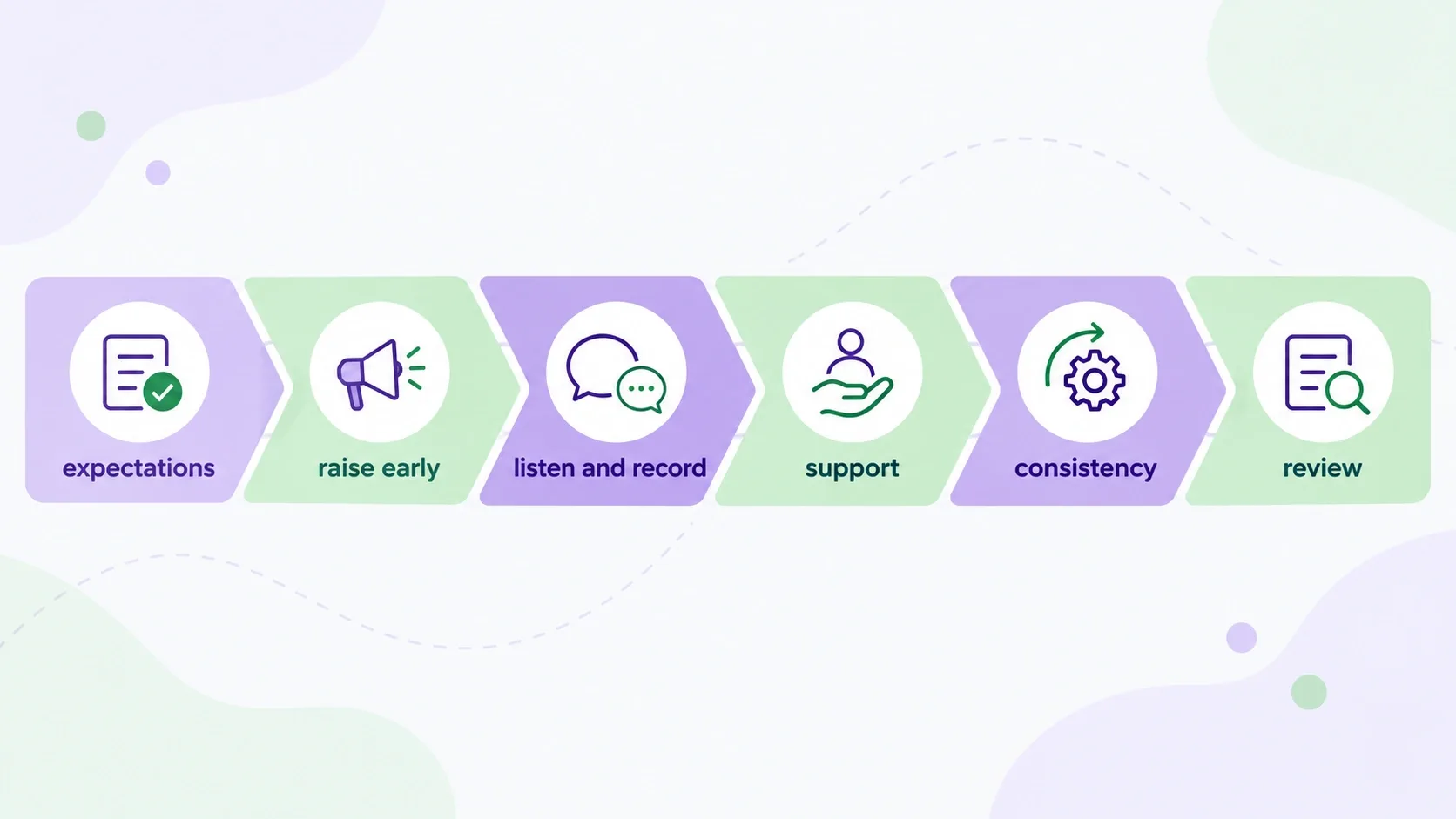
The eCompliance Central Fair Management Framework
This framework gives managers a repeatable process. Each step produces a record that supports a fair outcome and a defensible position.
A 6-Step Framework for Control
Set Clear Expectations
State the standard, the reason for it and how it will be measured, then confirm it in writing.
Raise Issues Early
Hold a private, specific conversation soon after the concern arises, before frustration builds.
Listen and Record
Invite the worker's view, consider their circumstances and keep dated notes of the discussion.
Agree Support and Timeframes
Offer practical help and a realistic period for improvement, and document what was agreed.
Apply the Process Consistently
Follow the policy or agreement, and treat comparable situations the same way across the team.
Review and Escalate
Check progress on the agreed date, then close the issue or move to the next formal step with HR.
Embedding the Process
A framework works only when managers can use it with confidence. Provide templates for notes, build the steps into onboarding for people leaders, and review outcomes by team each quarter.
Consequences of Getting It Wrong
Legal and Regulatory Exposure
Unreasonable management can lead to Fair Work Commission applications, WHS investigations, workers' compensation claims for psychological injury and discrimination complaints. Individually, a manager may also face scrutiny of their conduct.
A typical escalation looks like this:
- A manager delays a performance conversation, and the issue grows.
- The conversation finally happens without notes or support, and the worker feels targeted.
- The worker lodges a bullying or psychosocial complaint, and the PCBU cannot show its process.
Operational and Cultural Cost
Beyond enforcement, poor management drives absenteeism, turnover and disengagement. Teams also learn to avoid difficult topics, which hides risk.
In contrast, managers who handle conversations well build trust, and trust makes hazards visible sooner.
Compliance Intelligence: Key Insights
- ✓ Reasonable management action must be carried out in a reasonable manner to fall outside the bullying definition.
- ✓ A justified decision can still be delivered unreasonably.
- ✓ The Fair Work Commission cannot award compensation in anti-bullying matters.
- ✓ Poor management practices are recognised psychosocial hazards under WHS law.
- ✓ Contemporaneous notes carry more weight than later recollection.
- ✓ Consistency across comparable cases is a strong indicator of reasonableness.
- ✓ Training people leaders is a more effective control than reissuing a policy.
Key Takeaways
- Define reasonable management action in plain language for every people leader.
- Train managers in feedback, difficult conversations and note-taking.
- Document expectations, support offered and agreed timeframes in writing.
- Apply performance and conduct processes consistently across teams.
- Include management practices in the psychosocial risk assessment.
- Analyse complaints by team to find recurring patterns.
- Brief officers each quarter on management-related risk and outcomes.
Frequently Asked Questions
What is reasonable management action?
It is action taken by a manager to direct and control how work is carried out, such as giving feedback, allocating duties or running a performance process. Under the Fair Work Act 2009, it is not bullying if carried out in a reasonable manner. Both the action and the way it is done are assessed.
Can a manager give negative feedback without it being bullying?
Yes. Feedback on performance or conduct is a normal part of management. It should be specific, private, timely and respectful, and the worker should have a chance to respond. Documenting the discussion helps show the approach was reasonable.
When does management action become bullying?
It becomes a concern when behaviour is repeated, unreasonable and creates a risk to health and safety. Public humiliation, inconsistent treatment and unachievable targets are common warning signs. Each case depends on its facts.
How does WHS law apply to management practices?
Under the WHS Act 2011, a PCBU must manage risks to psychological health so far as is reasonably practicable. The Model WHS Regulations treat poor management practices as psychosocial hazards. Therefore, regulators may examine management systems even where no bullying finding is made.
What records should managers keep?
Managers should keep dated notes of expectations, conversations, support offered and outcomes. Records should be factual and stored securely. These notes help show that a process was fair if it is later questioned.
Can the Fair Work Commission order compensation for bullying?
No. In anti-bullying matters, the Commission can make orders to stop bullying but cannot order payment of money. Other avenues, such as workers' compensation or discrimination claims, may be separate, so organisations should seek legal advice on specific situations.
eCompliance Central are professional educators, not legal advisers. This article is general information only. For advice on your specific situation, please consult a qualified legal professional.
Equip Your Managers to Lead Fairly
eCompliance Central builds customised, SCORM-ready training around your policies, people and operations, so managers act with confidence and your records show it.
Explore Custom Compliance Solutions eCompliance Central content team, guided by Dr Denise Meyerson, PhD.