

AI Governance in Australian Workplaces: What Employers Must Control in 2026
AI governance in Australian workplaces has moved well beyond the IT department — it is now a live compliance obligation touching WHS law, privacy regulation, discrimination frameworks, and leadership accountability. This guide explains what Australian organisations must put in place to manage workplace AI risks responsibly in 2026.
Last updated on May 19, 2026
Why Workplace AI Is Now a Compliance Issue, Not Just a Technology Issue
AI Is Already Embedded in Australian Workplaces
Artificial intelligence is no longer an emerging workplace issue. Indeed, it is already embedded inside recruitment systems, employee monitoring tools, learning platforms, customer service workflows, document generation, risk management systems, and day-to-day decision-making across Australian organisations.
What many employers still underestimate, however, is that workplace AI is now creating a new category of compliance exposure — one that sits across psychosocial hazards, privacy obligations, discrimination law, governance accountability, and workplace behaviour simultaneously.
The Governance Gap Most Organisations Cannot See
The compliance risk is no longer limited to whether employees are using generative AI tools informally at work. In reality, the deeper issue is whether organisations have formal controls governing how AI systems influence decisions, workloads, employee wellbeing, information handling, behavioural expectations, and leadership accountability.
Australian regulators are increasingly focusing on governance systems rather than isolated incidents. Consequently, organisations without documented AI governance controls may struggle to demonstrate due diligence, safe systems of work, procedural fairness, or reasonable risk management if problems emerge.
A Behavioural Compliance Issue, Not Just a Technical One
For HR leaders, WHS managers, compliance officers, and PCBUs, AI governance is rapidly becoming a behavioural compliance issue — not simply a technology issue. Crucially, the controls organisations need are not primarily technical in nature. Rather, they are structural, cultural, and leadership-driven — and that distinction matters enormously for how compliance responsibilities are allocated.
Consequently, compliance training, documented governance frameworks, and leadership capability are now central to any credible response to workplace AI risk.
Executive Summary
- What this blog covers: AI governance obligations, workplace compliance risks, and practical AI control frameworks for Australian employers in 2026.
- Who it’s for: HR leaders, WHS managers, compliance officers, directors, PCBUs, governance teams, and L&D managers across Australian organisations.
- Key regulatory context: WHS Act 2011, Privacy Act 1988, Fair Work Act 2009, Sex Discrimination Act 1984, and Positive Duty obligations under Australian law.
- The central risk: Uncontrolled workplace AI use creating simultaneous psychosocial, privacy, discrimination, governance, and behavioural compliance risks.
- Primary action required: Implement documented AI governance controls, behavioural compliance standards, leadership accountability structures, and workforce training programmes.
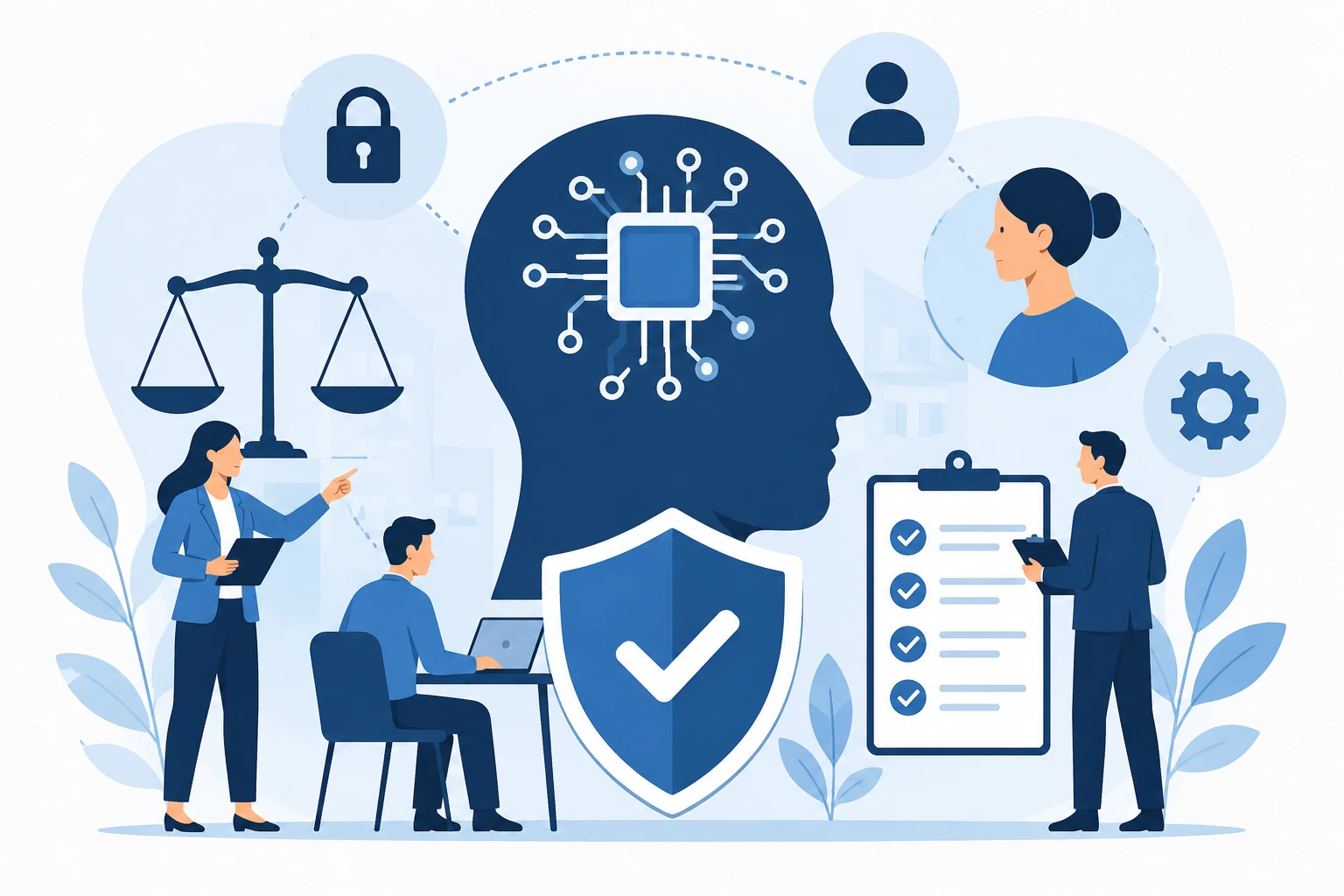
What AI Governance in Australian Workplaces Actually Means
A Practical Definition for Compliance Professionals
AI governance refers to the systems, controls, policies, oversight mechanisms, and accountability structures organisations use to manage how artificial intelligence tools operate within the workplace. In practical terms, therefore, it covers how AI tools get used, who can use them, what decisions AI can influence, what risks leadership monitors, and what evidence the organisation holds to demonstrate due diligence.
Where AI Governance Obligations Intersect With Existing Law
Many organisations still treat AI as an IT or innovation issue. However, Australian regulators increasingly view it quite differently. When AI systems influence recruitment outcomes, employee monitoring, performance management, workload allocation, communications, behavioural expectations, or access to information, the organisation may trigger obligations across multiple legislative frameworks simultaneously.
The key compliance domains where AI governance intersects with existing Australian law include:
- WHS obligations: psychosocial hazards arising from AI-driven monitoring, workload pressure, role ambiguity, and surveillance practices
- Privacy Act 1988: lawful handling of employee data processed by AI systems, including storage, access, and disclosure controls
- Sex Discrimination Act and Positive Duty: preventing AI systems from reinforcing discriminatory recruitment or performance outcomes
- Fair Work Act 2009: maintaining procedural fairness in AI-assisted disciplinary, performance, and roster decisions
- Officer due diligence: directors and officers demonstrating awareness of AI-related organisational risks and governance controls
Why AI Governance Is Also a Cultural Issue
Governance frameworks only function when leadership actively models the behaviours they require. Moreover, if AI governance policies exist on paper but are ignored in practice, the organisation faces both the original risk and a secondary governance failure — the gap between documented standards and actual workplace behaviour.
This is precisely why behavioural compliance training is essential. Policies communicate expectations, but training is what embeds them into daily practice. Without that training investment, governance frameworks rarely translate into consistent workplace behaviour across teams, levels, and locations.
Why Uncontrolled AI Use Creates Systemic Organisational Risk
The Absence of Behavioural Controls Is the Core Problem
The primary compliance problem with workplace AI is not the technology itself. Rather, it is the absence of behavioural controls, leadership oversight, and documented governance systems around its use. Many Australian organisations now have employees using generative AI tools informally without approved usage standards, privacy controls, information handling protocols, escalation pathways, or leadership guidance. As a result, a range of specific failure modes have emerged across industries:
- Employees inadvertently disclosing confidential information via public AI platforms
- Managers using AI-generated performance feedback that introduces discriminatory language or procedural unfairness
- Recruitment teams relying on automated screening systems without understanding embedded bias risks
- AI-generated communications normalising language or tone that would be unacceptable if written by a human
How These Failures Become Systemic Rather Than Isolated
These are not isolated technology problems. Instead, they are organisational control failures — and they compound over time. Each informal workaround or ungoverned AI interaction adds to an accumulating governance deficit that becomes increasingly harder to address once formal complaints or regulatory scrutiny emerge.
Under Australian WHS obligations, PCBUs must eliminate or minimise risks so far as is reasonably practicable. Consequently, that obligation increasingly includes psychosocial hazards associated with workload pressure, surveillance practices, role ambiguity, unrealistic productivity expectations, and unsafe workplace behaviour. AI systems can contribute to all of these hazards if poorly governed.
The consequence chain typically looks like this: uncontrolled AI use leads to behavioural inconsistency, which in turn creates psychosocial risk, which generates employee complaints, which triggers regulatory scrutiny, and ultimately produces governance exposure. By the time the final step is reached, the original problem has been present for months or years.
The Invisible Behavioural Risks of Informal AI Dependence
One of the most overlooked AI governance risks is the gradual normalisation of informal AI dependence inside workplace culture. Typically, this develops quietly, without a single trigger event. Over time, employees begin using AI tools to write emails, summarise incidents, generate HR documentation, draft policies, create investigation notes, assess candidates, or produce manager communications. Among the specific risks this creates inside organisational behaviour are:
- Reduced critical thinking and diminished human judgement in high-stakes decisions
- Inconsistent documentation quality across teams and locations
- Behavioural disengagement and increased compliance inaccuracies
- Erosion of leadership accountability as managers defer to AI-generated outputs
In psychosocial hazard environments, furthermore, these risks become particularly serious. AI-generated performance messaging may appear impersonal or punitive to workers receiving it. Sustained automated monitoring, similarly, creates ongoing psychological pressure that employees struggle to separate from human management decisions. Over time, workers may feel permanently surveilled — and that perception alone is sufficient to trigger psychosocial hazard obligations under the WHS Act 2011. These outcomes directly affect psychological safety, reporting culture, and employee wellbeing — often before any formal incident is recorded.
Why These Risks Appear Before Any Formal Complaint Is Lodged
Critically, many of these behavioural and cultural risks emerge well before formal complaints or WHS incidents trigger regulatory attention. Organisations relying solely on complaint-based detection models therefore already operate behind the risk curve. By the time a formal report arrives, the underlying governance deficit has typically persisted for months — and the organisation loses much of its ability to demonstrate proactive controls.

The Australian Regulatory Landscape Around Workplace AI Governance
Existing Legislation Already Creates Substantial Exposure
Australia does not yet have a single standalone AI workplace law. However, that does not mean organisations lack obligations — existing legislation already creates substantial compliance exposure wherever AI systems affect workers, workplace decisions, or organisational behaviour. The WHS Act 2011 and Model WHS Regulations, for instance, require organisations to manage psychosocial hazards and maintain safe systems of work.
Where AI systems contribute to excessive monitoring, unreasonable performance pressure, role insecurity, confusion, workplace isolation, or unsafe managerial behaviour, those risks may fall squarely within psychosocial risk control obligations. Furthermore, Safe Work Australia guidance increasingly emphasises systems-level prevention rather than reactive intervention — regulators expect organisations to identify and control systemic risks before harm occurs, not respond to complaints after the fact.
What Regulators Are Looking For Across Key Frameworks
Across Australian regulatory frameworks, there are consistent expectations that apply directly to AI governance in workplaces. Organisations must be able to demonstrate controls in each of the following areas:
- Privacy Act 1988: lawful handling, secure storage, controlled access, and transparent disclosure practices for employee data processed by AI systems
- Positive Duty obligations: proactive measures to prevent AI systems from reinforcing discriminatory recruitment, monitoring, or performance outcomes
- Fair Work Act 2009: procedural fairness in AI-assisted decisions, including the ability to explain how AI-influenced decisions were reached
- Officer due diligence: directors and officers demonstrating awareness of AI-related risks, oversight of governance systems, and evidence of reasonable controls
- WHS Act 2011: documented psychosocial risk assessments that account for AI-related hazards including surveillance, workload pressure, and role ambiguity
Accordingly, documentation becomes critical across all of these frameworks. If an organisation cannot explain how an AI-influenced decision was made, or cannot demonstrate that governance controls existed and were actively maintained, regulatory exposure increases significantly.
Why Proactive Controls Matter More Than Reactive Responses
Regulators increasingly assess whether organisations implemented proactive controls — not simply whether they reacted after harm occurred. This distinction is fundamental to how AI governance exposure should be understood. Reactive compliance — responding to complaints, investigations, or incidents — places organisations in a significantly weaker position than those that identified risks, implemented controls, trained their workforce, and maintained documentation before any harm emerged.
Early intervention is not a soft HR concept in this context. Rather, it is a formal compliance control. Organisations that identify emerging behavioural risks early, provide leadership guidance, reinforce reporting culture, and document corrective action are substantially better positioned to demonstrate compliance maturity and due diligence under Australian law.
Leadership Accountability and Due Diligence in AI Governance
Why AI Governance Cannot Sit Solely Within IT
AI governance cannot sit exclusively within IT departments. Rather, under Australian WHS obligations, directors, officers, and PCBUs must exercise due diligence regarding organisational risks and compliance systems. That includes understanding how workplace AI tools operate, what risks they create, what controls exist, how workers are trained, and how incidents are escalated and reviewed. Specifically, leadership accountability obligations in this space include:
- Understanding the nature of AI risks at an operational level, not just in principle
- Ensuring governance frameworks are implemented consistently across teams and locations
- Authorising and resourcing compliance training that covers AI behavioural risks
- Reviewing and approving AI-related incident escalation pathways and reporting mechanisms
What Managers Need to Understand About AI Behavioural Risk
Managers require practical guidance around acceptable AI use, confidentiality obligations, procedural fairness, communication standards, bias awareness, and escalation responsibilities. This is not optional capability — rather, it is a core component of leadership compliance in 2026. In particular, managers need to understand:
- What AI tools are approved for use in their team and under what conditions
- How to identify when AI-assisted outputs may introduce bias, inaccuracy, or procedural unfairness
- When human review and override is required before an AI-influenced decision is actioned
- How to support employees who raise concerns about AI-related workplace behaviour
The Invisible Risk of Inconsistent Leadership Behaviour
Inconsistent leadership behaviour across the organisation represents one of the most damaging invisible risks. When one manager uses AI heavily while another prohibits it entirely, organisations consequently create fragmented workplace standards and inconsistent compliance controls. This undermines organisational culture, creates confusion about acceptable norms, and increases governance exposure when regulators assess whether the organisation maintained a coherent and reasonable system of control.
Therefore, strong AI governance requires executive oversight, documented accountability, operational consistency, clear behavioural expectations, and formal compliance frameworks that apply equally across all levels of the organisation.
The Second-Order Risks of Weak Workplace AI Governance
How Governance Failures Accumulate Over Time
The consequences of poor AI governance rarely appear immediately. Instead, organisations typically experience fragmented decision-making, inconsistent behaviour, declining trust, reporting hesitation, documentation failures, and increased psychosocial risk over time. Each of these signals is a governance indicator — an early warning that controls are insufficient or unenforced.
Why Human Oversight Cannot Be Replaced by AI Alone
The danger is not simply incorrect AI output. Rather, it is the erosion of human oversight inside systems that require judgement, context, empathy, procedural fairness, and risk awareness. When AI gradually displaces these human elements in decision-making without formal governance controls, organisations become structurally vulnerable in ways that are difficult to diagnose until a formal complaint or regulatory inquiry forces the issue.
This is precisely why compliance training, leadership capability, and reporting culture are now central to effective AI governance — not peripheral to it.
What Weak Governance Eventually Produces
Eventually, accumulated governance deficits may trigger formal consequences including employee complaints, privacy incidents, unfair treatment allegations, WHS investigations, reputational damage, and governance scrutiny. Notably, the organisations most exposed in coming years will not necessarily be those using the most AI — rather, exposure will fall hardest on those using AI without any governance systems in place. Among the key second-order risks that weak governance creates are:
- Reputational damage from high-profile AI-related incidents or investigations
- Regulatory scrutiny from Safe Work Australia, the Office of the Australian Information Commissioner, or the Australian Human Rights Commission
- Cultural instability as employee trust in leadership and organisational systems deteriorates
- Governance exposure where officers cannot demonstrate reasonable due diligence or documented risk management
Why Reporting Culture Is Now an AI Governance Control
Reporting culture — the extent to which employees feel safe identifying and escalating concerns — is now a formal component of effective AI governance. Accordingly, when employees identify inappropriate AI use, governance failures, or emerging behavioural risks, organisations must have functioning reporting pathways that are accessible, trusted, and free from retaliation risk.
Without a strong reporting culture, governance failures remain invisible to leadership until they become formal incidents. Furthermore, building reporting culture requires both structural mechanisms and leadership behaviour that actively models and reinforces psychological safety at every level of the organisation.
The eCompliance Central AI Governance Control Framework
Effective workplace AI governance in Australian organisations requires more than a policy document. Organisations need an operational compliance framework that integrates behavioural controls, leadership accountability, documentation standards, and risk management processes that actually function in practice — not just on paper.
A 6-Step Framework for Control
Identify AI Exposure
Audit all workplace AI usage — approved and unapproved. Identify where AI influences decisions, workloads, or employee behaviour. Map privacy, WHS, and governance exposure points across the organisation.
Define Acceptable Use Standards
Create clear, written AI usage rules. Establish confidentiality controls, define prohibited activities, and clarify when human review and override is required before any AI-influenced decision is actioned.
Deliver Behavioural Compliance Training
Train workers on acceptable AI use and confidentiality obligations. Managers also need targeted guidance on procedural fairness risks, bias awareness, and psychosocial risk impacts. Embed AI governance into existing code of conduct training programmes.
Establish Leadership Oversight
Assign named governance accountability at leadership level. Create functioning escalation pathways for AI-related concerns. Review psychosocial risk impacts from AI tools and monitor emerging behavioural trends across teams.
Build Reporting Culture
Ensure employees have accessible, trusted pathways to raise AI-related concerns without fear of retaliation. Model psychological safety at leadership level. Treat AI-related reports as governance intelligence, not isolated incidents.
Document, Review, and Update
Maintain governance records and audit AI-related incidents. Review policy effectiveness regularly. Update controls as AI technology evolves and as regulatory expectations in Australian workplaces become more specific.
Why This Framework Produces Evidence of Due Diligence
Altogether, this framework delivers operational practicality — not just structural completeness. Each step generates concrete evidence that the organisation exercised due diligence, maintained safe systems of work, and took reasonably practicable steps to manage AI-related workplace risks under Australian law. Organisations that work through each stage systematically build a defensible compliance record that regulators and courts can assess.
What Organisations Without AI Governance Controls Are Risking
The Consequences Are Systemic, Not Just Incident-Based
Weak AI governance does not produce a single, identifiable failure event. Instead, it produces a pattern of compounding organisational risk that is difficult to diagnose and expensive to remediate. Organisations that lack documented AI governance controls face a realistic consequence chain that looks like this:
The governance failure chain for uncontrolled AI use:
- Informal AI dependence normalises without leadership oversight or behavioural standards
- Psychosocial risk accumulates as monitoring, workload pressure, and role ambiguity increase undetected
- Formal complaints, privacy incidents, or regulatory inquiries arrive — and the organisation can no longer point to proactive controls as a defence
The Regulatory Scrutiny Is Already Increasing
Australian regulators including Safe Work Australia, the Office of the Australian Information Commissioner, and the Australian Human Rights Commission are all increasing their focus on governance systems rather than isolated incidents. As a result, a single AI-related workplace complaint may now trigger a broader review of the organisation’s governance controls — not just an investigation into the specific event.
Organisations that can demonstrate proactive governance — documented controls, trained workforces, leadership accountability, and maintained records — are therefore substantially better positioned to respond to regulatory scrutiny than those relying on reactive compliance after harm has occurred.
Compliance Intelligence: Key Insights
Key Takeaways
- Develop a documented workplace AI governance framework rather than relying on informal expectations or ad hoc controls.
- Treat AI governance as a behavioural compliance and WHS obligation — not solely as an IT or innovation management responsibility.
- Train managers on procedural fairness, privacy obligations, and psychosocial risk impacts directly linked to workplace AI use.
- Implement clear reporting pathways for AI-related concerns, misuse, or governance failures across all teams and locations.
- Audit where AI tools are already influencing workplace decisions, communications, and organisational behaviour — before regulators do it for you.
- Use early intervention to address emerging AI-related behavioural risks before formal incidents occur and governance exposure increases.
- Maintain documentation demonstrating governance oversight, risk management, training delivery, and leadership accountability as evidence of due diligence.
Frequently Asked Questions
Managing AI Governance Obligations
How are Australian employers expected to manage AI governance risks at work in 2026?
Can workplace AI systems create psychosocial hazards under Australian WHS law?
Policies and Governance Policy Requirements
What should a workplace AI governance policy include for Australian organisations?
Do small businesses have AI governance obligations under Australian law?
Accountability and Common Governance Mistakes
Who should be responsible for workplace AI governance in an Australian organisation?
What is the biggest AI governance mistake Australian organisations are currently making?
Ready to Build Real AI Governance Controls for Your Workplace?
eCompliance Central helps Australian organisations move beyond generic policies with customised, SCORM-ready compliance training modules built around your AI governance obligations, your people, and your operational realities. Talk to us about a custom build or explore our existing compliance module library.
Explore Custom Compliance Solutions
Looking for a broader overview?
Read our definitive Australian Workplace Compliance Guide.